The Ron Evenden Photography Collection
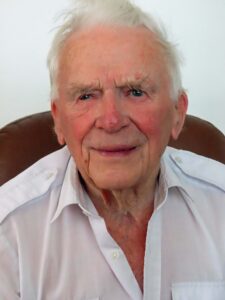
Ron and his wife Joan have been members of the BNSS since 2015. On retirement Ron took up wildlife photography.
In February 2026 Ron donated his entire works of wildlife and nature photographs to BNSS, where they will ultimately be catalogued and stored. His collection includes hundreds of 35mm slides, plus digital images and some prints. It is hoped to exhibit some of Ron’s photographs in the Museum in the future, but for now a selection are available to view below.
An interview with Ron Evenden May 2026
Ron started with butterflies, damsel and dragonflies and then decided he wanted to move up a size, so he started photographing whales. This became a passion and took him to various sites from the Arctic to Antarctica. He photographed Fin, Blue and Humpback whales and many other species of whales and dolphins.
His most spectacular shot was of a fin whale breaching, which happened on his first whale tour. He was standing on the fore deck of a launch when someone shouted ‘Look!’ Ron turned, saw the breaching whale but had no time to adjust the lens of the camera. He only had time to press the button!
Two years later on a tour in the Caribbean he met whale expert, Mark Carwardine and whilst chatting to him Ron discovered that fin whales rarely breach. When Ron sent a copy of his photo to Mark, he promptly replied: ‘This whale rarely breaches and this shot is the finest one known of this behaviour!’ If Ron hadn’t have been on that tour and chatted to Mark, he would never have known how rare this photograph was.
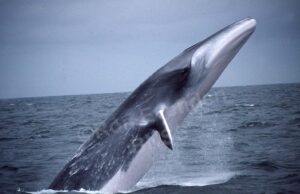
Ron’s photograph was subsequently published on the front cover of the Whale and Dolphin Conservation Society (WDC) magazine, and also used in a campaign against whaling in Iceland, with a full-page advert in two UK daily newspapers during October 1997.
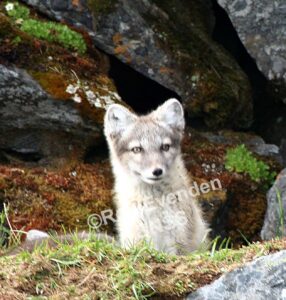
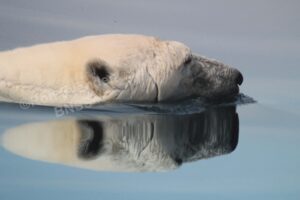
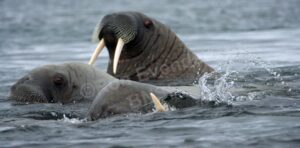
During a visit to the Arctic Ron photographed Arctic fox, Polar bears, Walrus and flowers. On one memorable occasion whilst in a 25 foot launch he photographed a Polar bear swimming just 6 feet away!
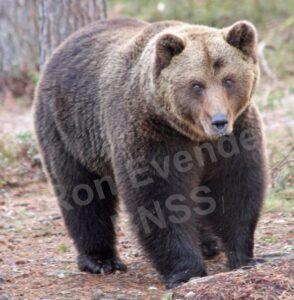
In sub-arctic regions Ron photographed White-tailed Eagles in Norway, Golden Eagles, Brown bears and the Great Gray Owl in Finland.
Despite the frustrations and missed opportunities there are also those times when looking back that bring a smile to his face. His most memorable missed opportunity concerned a Dartford Warbler in the New Forest. Having waited patiently for several hours watching one flying in and out of the gorse bushes he failed to take a decent photo. Preparing to go home Ron went behind a bush and whilst he ‘was doing what a man has to do’ the Warbler landed on the ground only feet away! This was the longest and best sighting of the Dartford Warbler he has ever had and there was nothing he could do about it.
Ron tells the story behind his stunning photograph of two badgers. One day he saw a badger in the garden, and they started putting out food for it. Soon a hedgehog and fox got to know of this, so they had three species in the garden at the same time. The hedgehog would come first, and then the badger would arrive. On one occasion the hedgehog hadn’t finished eating so he curled up in the middle of the plate of food. The badger then nudged the hedgehog out of the way until he could get to the food.
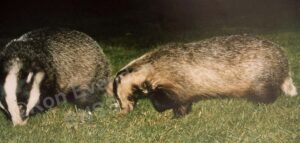
The fox would usually wait for the others to finish, but one day he got impatient and nipped the badger on its rear end. As the badger turned to face him, the fox ran round in a circle, scooped up a mouthful of food and made off with it.
A friend visited Ron, along with his Dutch friend, to see the badger in his garden. They asked to see his photograph of the two badgers. This was pre-digital days and they wanted to know how many flash guns he had used, where he had placed them, and all the details. The Dutchman took a long look at the photo, handed it back to Ron and said: ‘You’re a good flasher!’ Ron commented, ‘it’s gratifying to know that I am good at something!’ [In case you are interested, Ron used two flashguns; one on the badgers and one lighting the background.]
Camera Equipment
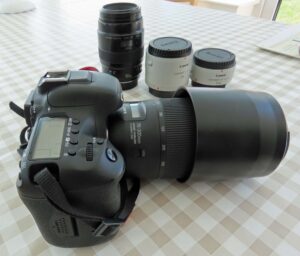
For the 30+ years that Ron has been specialising in wildlife photography, he has favoured Canon cameras and lenses. His latest camera is a Canon EOS7D Mark II body and a ‘workhorse’ 70-300mm lens with image stabilizer, which can be used anywhere, especially when a tripod is impossible to use.
He also uses a 100-400mm f/4.5-5.6L, used with a 1.4x extender, a weighty EF 300mm, 1:28 used with a 2x extender, and a 100mm macro lens for close-ups.