by Jez Martin, Biodiversity Officer, BCP
As part of surveying bat distribution throughout the BCP area, it was agreed agreed that I could put up a bat detector in the BNSS grounds.
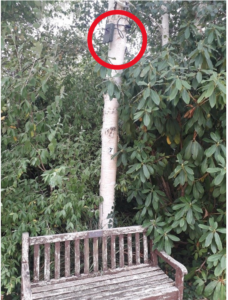 On 19th August 2025 I put up an Anabat Express converted to full spectrum, on a tree as shown in photo, with it taken down on 26th August 2025.
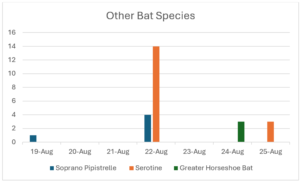
I expected to record Common and Soprano Pipistrelle, and then at least one from Nathusius’ Pipistrelle, Serotine, Noctule and a Myotis species. I was very surprised to find recordings on 24th August had 3 files of Greater Horseshoe Bat!
At first it seemed a well-lit area for this species, but travelling along the coast offers quite a wooded area to fly through, to reach BNSS, with only the lights on the promenade and East Overcliff Drive as the main light issue. I would think this was a wandering male looking for females for the upcoming mating season.
As first recorded at 20:42, with sunset that night 20:09, suggests that had been roosting within 3 km of BNSS. Could it have been using derelict building at 61-63 Christchurch Road?
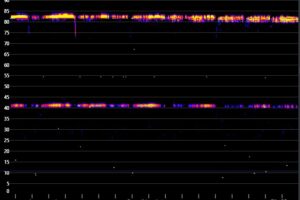
Below:
Sonagram showing one Greater Horseshoe Bat calls.
True call at 82 KHz, at 41 KHz that is a harmonic.
Besides this surprise, as expected Common Pipistrelle was the most common species. On 19th August the first recording was 9 minutes after sunset, so clearly roosting nearby, possibly in a nearby bat box, or buildings or trees. While Serotine and Soprano Pipistrelle, were recorded 2 hours after sunset so the roost could be long way away.
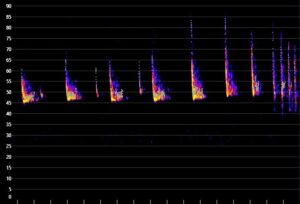
Below: Screenshot of Common Pipistrelle call,
showing typical hockey stick shape to call,
ending with feeding buzz on the right.
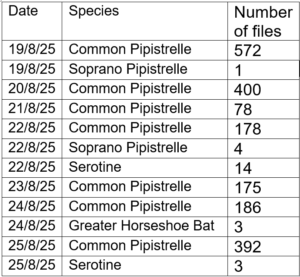
The number of files is generated by detector software; some will be one call but at times one call may be split over two files or even more.
Below table of results
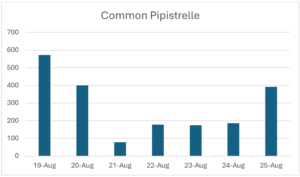
Bar chart of results for Common Pipistrelle
(as other 3 species low numbers compared to this species not visible on a combined chart).
Bar chart for Soprano Pipistrelle, Serotine and Greater Horseshoe Bat.
There was a lot of activity after sunset, then generally very little activity until around 2am, then more from 4am to sunrise – the bat equivalent of breakfast, lunch and dinner!
I was surprised that there were only a few Soprano Pipistrelle calls, I expected slightly more.
There was quite a bit of variation in Common Pipistrelle per night, with no obvious explanation like significant weather events, but it does show that surveying for one or a few nights could underestimate the importance of a site for bats, so survey on just 21st or 21st to 23rd would show lower level of use and no Greater Horseshoe Bat.
Usually, a peak in the number of files applies to all species, but here a peak for Soprano Pipistrelle and Serotine showed a relatively low number for Common Pipistrelle.
BNSS proved better for bats than nearby the sites of Churchill Gardens and Shelley Park, but Woodland Walk, near Corpus Christi Church off Christchurch Road, has a wider range of bat species present per night and over 1000 files of Common Pipistrelle per night, but no Greater Horseshoe Bat!
Of the 18 species of bat in the UK, 15 species have been recorded in BCP area with the missing ones being Alcathoe Bat, Lesser Horseshoe Bat and Greater Mouse-eared Bat. It is unknown how many of these breed in BCP area.
Results of this survey have been submitted to Dorset Environmental Records Centre (DERC).


